Running the shop
How to close out your cash drawer
Opening float, cash in and out, what counts as expected cash, how to count at closing and what to do about a shortage or an overage.
Updated Monday 28 September 2026 · 6 minute read
Closing out the drawer answers one simple question: is the cash in the drawer the cash that should be there? To answer it you need to know what you started with, what came in and went out during the shift, and to count at the end. If any of the three is done halfway, the closeout stops telling you anything useful and turns into a subtraction that never balances.
The opening float
Every shift starts with a float: the cash you leave in the drawer to make change from the first sale. It is counted at opening, in front of whoever takes the shift, and written down.
- The same amount every time makes a mistake easier to spot: with a fixed float, any difference at opening stands out.
- In small bills and coins. A float in large bills can’t make change.
- Counted, not assumed. “Whatever was left from yesterday” isn’t a float; it is a figure nobody checked.
What goes into expected cash
Expected cash at closing is the float plus all the cash that came in, minus all the cash that went out. It sounds obvious, but this is where people slip most, because not everything you take in is cash.
| Movement | Does it change the cash in the drawer? |
|---|---|
| Sale paid in cash | Yes, adds |
| Layaway deposit paid in cash | Yes, adds |
| Cash refund for a return | Yes, subtracts |
| Cash in that isn’t a sale (change the owner brought) | Yes, adds |
| Cash out that isn’t a sale (paying the water delivery, a withdrawal) | Yes, subtracts |
| Card sale | No |
| Bank transfer sale | No |
| Payment with a gift card | No |
| Sale of a gift card paid in cash | Yes, adds |
Two cases that confuse people:
- The cash part of a split payment. If a customer pays part by card and part in cash, only the cash part counts.
- Gift cards. The cash comes in the day the card is sold. The day the customer uses it to pay, not a peso comes in: that money was already in the drawer.
Cash in and out: always with a reason
The most common cause of a shortage isn’t theft: it is a payout nobody wrote down. Paying the water delivery, taking cash next door for change, the owner taking cash to the bank at midday. Each of those, if not recorded, shows up at closing as missing money.
The rule is simple: every bit of cash that enters or leaves the drawer without being a sale is recorded on the spot, with the amount and a reason anyone can understand later (“paid water supplier”, “withdrawal for deposit”, “change”). If there is a receipt, keep it with the closeout.
Counting at closing
- Stop taking cash while you count, or count at a quiet moment.
- Count by denomination: how many bills of each value and how many coins. It is slower than counting the pile, but if there is a difference you know where to look.
- Count before you look at the expected figure. If you know what should be there, you’ll unconsciously “find” that number.
- Set aside the next shift’s float, if it stays in the drawer, and take out the rest.
- Write down the difference and, if there is one, whatever you know about it.
Shortages and overages
The difference is counted minus expected. Negative is a shortage; positive, an overage. Both deserve attention: an overage also says something wasn’t recorded.
Before drawing conclusions, check in this order:
- Unrecorded payouts. Ask whoever worked the shift. It almost always turns up.
- Sales rung up with the wrong method. A sale entered as cash that the customer paid by card creates a shortage; the reverse, an overage.
- Wrong change given. Usually a small, round amount.
- Counting mistake. Count again, with someone else.
Whatever can’t be explained goes into the closeout notes as it is. You don’t “fix” it by adding or removing money until it balances: that erases the only clue you had. More than any single day, what matters is the running difference across many closeouts: a shop that comes up a little short every day has a habit to fix, not a bad day.
One drawer, one person responsible
- One drawer per shift. If two shifts share the drawer without closing out in between, a difference can’t be traced to anyone.
- Who opened and who closed, on record. It isn’t about distrust: if the person who closed isn’t the one who opened, you want to know that when reviewing.
- A closed drawer isn’t reopened. If you entered something wrong, note it on the next shift and correct it with a movement that has a reason. Rewriting an old closeout makes none of them trustworthy.
Closing out in Atiéndalo
In Atiéndalo the closeout lives under Registers. You open with the float you counted, record each cash in or out with its reason, and at closing you enter what you counted: the difference is worked out for you. Expected cash adds the cash payments from sales and layaway deposits, subtracts cash refunds and applies the movements; card, transfer and gift card payments don’t touch it. Only one register can be open at a time in the whole shop, each one records who opened and who closed it, and a closed register can’t be reopened. If you turn it on, the point of sale won’t charge without an open register.
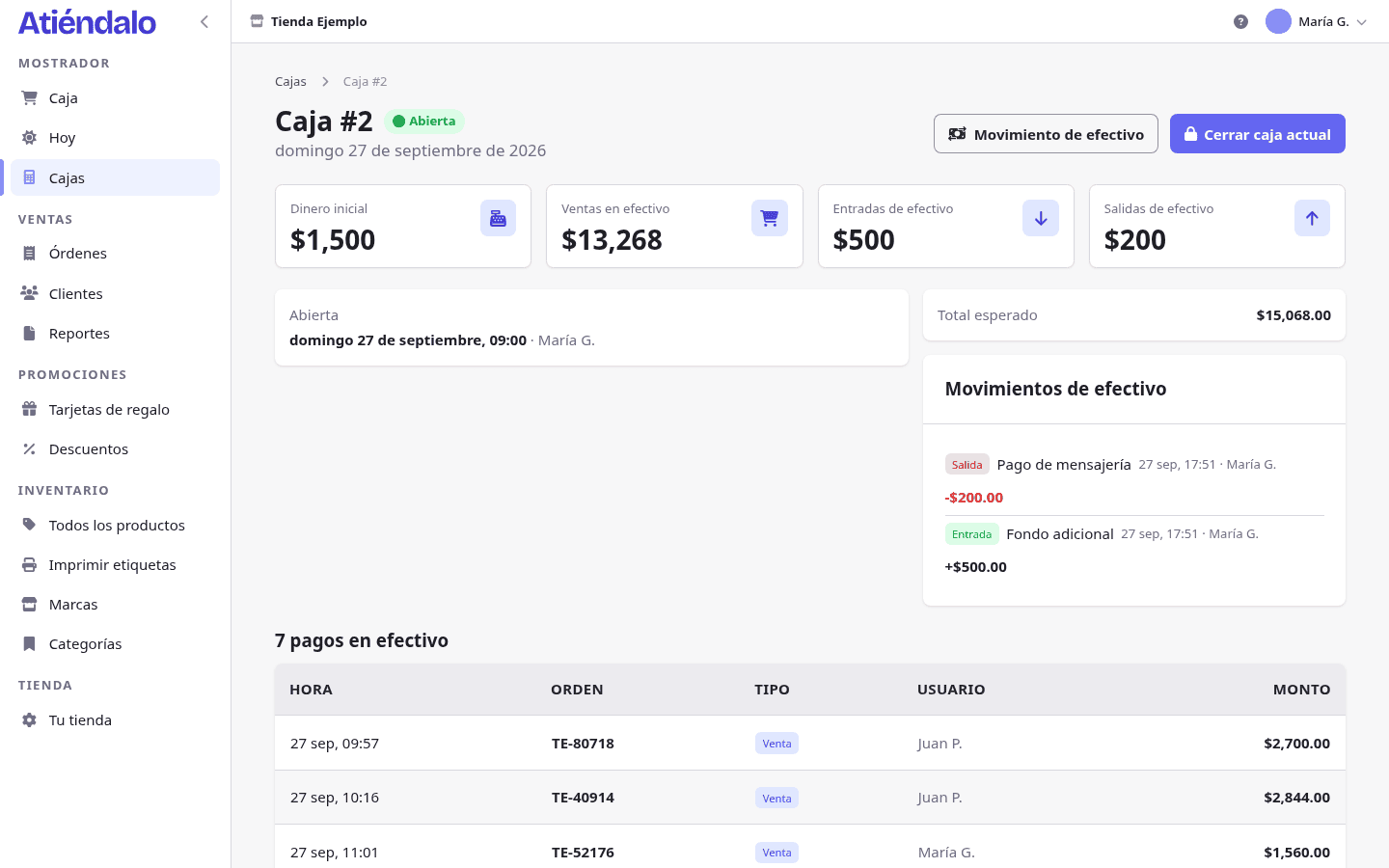
The register list shows the running difference for the period, and each register has its own page with every cash payment that went through it. Everything Atiéndalo does is on Features; if you already use it, the step by step is in Cash register & closing.

If you already use Atiéndalo
- Cash register & closing — Open with a float, record cash in and out, and close by counting the shift's cash.
- Gift cards — Sell prepaid cards at the counter and take their balance as payment.